2025 Performance Highlights (G)
- Total professional training hours for all 28 directors and supervisors of the 5th Board in 2025: 233 hours.
- Conducted 20 corporate integrity promotion and site visit activities, 41 anti-corruption awareness activities, five “Integrity Ethics” training sessions for new employees, one briefing session on the Act on Property-Declaration by Public Servants, one briefing session on the Act on Recusal of Public Servants Due to Conflicts of Interest, and 18 integrity and legal compliance training sessions.
- On 4 August 2025, TIPC and the Maritime and Port Bureau jointly organized the “Sailing Together for Green Integrity and Sustainability – 2025 Green Energy Corporate Integrity Forum”. The event brought together 101 representatives from the shipping, shipping agency, offshore wind power, maritime technology, government, academia, and industry association sectors to discuss how public-private collaboration can advance navigational safety, occupational safety, integrity governance, and whistleblower protection in Taiwan's offshore wind industry.
- Conducted two annual training sessions on legal issues related to the use of generative AI (including trade secret protection) and three training sessions on common legal issues arising from contract performance disputes.
- Delivered a “Basic Introduction to Law” course to 151 new employees during the reporting year.
- One session of risk management and internal control training was completed.
- Established the Procedures for the Entry and Departure of Special Operations Vessels to enhance navigational safety within port waters.
- In accordance with the Guidelines for the Signing of the Statement of Internal Control by Government Agencies, the Chairperson, President, and Auditor General jointly signed the Statement of Internal Control in March 2025 and submitted through the Internal Control Statement Declaration System.
Comply with the SDGs
- SDG 16【SDG16.5;SDG16.6;SDG16.7;SDG16.10;SDG16.b】
Management Policy
Covered material topics
- Integrity Governance
-
Regulatory Compliance
-
Operational Risk Management
Policy
- Operation of the Board of Directors
- Internal Control System
- Ethics and Integrity
Management Evaluation System
- Annual Self-Assessment and Evaluation of Directors and Super visors
- Risk Management and Internal Control System
- Integrity Risk Management
- Internal Audit System
- Procurement Audit System
Composition of Board of Directors
The Ministry of Transportation and Communications (MOTC) is TIPC’s sole shareholder, and all directors and supervisors are appointed by the Ministry in accordance with Article 4 of the “Taiwan International Ports Corporation, Ltd. Establishment Act.” The Board of Directors serves as the Company’s highest governance body and is primarily responsible for reviewing operational proposals submitted by the management team. The scope of its review includes business plans, investment projects, budgets, and operational changes. Resolutions adopted by the Board are subject to regular follow-up, with the relevant management departments required to report on their implementation status.
To strengthen the functions of the Board and enhance decision-making efficiency, TIPC has established the Board Agenda Committee to review whether proposed agenda items involve matters requiring Board approval. The Committee is composed of the Company’s labor directors and is convened by the Chairperson. Proposals approved by the Committee are submitted to the Board of Directors for deliberation and resolution, while those not approved are referred back to the management team for further review or processing.
In 2025, the 5th Board of Directors convened four regular meetings and four extraordinary meetings. During the year, the Board considered a total of 47 agenda items, comprising 24 reports, 19 discussion items, one election item, and three matters for ratification. The average attendance rate of the 5th Board of Directors in 2025 was 81%.
TIPC’s directors and supervisors serve three-year terms. The Board comprises experts with professional expertise in transportation, business management, finance and taxation, risk management, law, engineering, sustainability, and other relevant fields. In addition, several directors serve as representatives nominated by central government ministries and agencies, as well as by the county and city governments where the ports are located. Five labor directors are elected by TIPC’s labor unions, representing the unions of the Keelung, Taichung, Kaohsiung, and Hualien branches.
For detailed information on TIPC’s directors and supervisors, please refer to the “Board of Directors” section of the Company’s official website under Home > About TIPC > Organization and Management > Board of Directors. Information on the professional backgrounds and training of Board members is available on TIPC’s ESG Sustainability website under ESG Practices > Sustainability Information Disclosure.
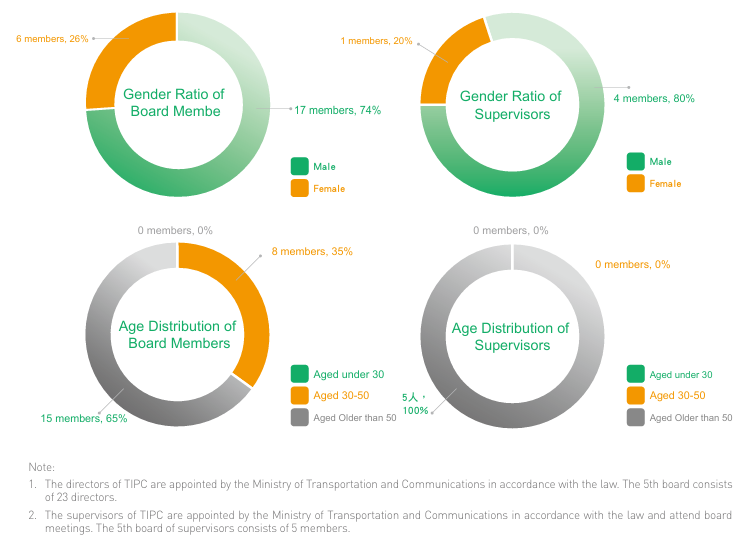
Gender Ratio and Age Distribution of Board Members
Continuing Education and Training of Directors and Supervisors
TIPC encourages its directors and supervisors to participate in continuing education each year, with reference to the ‘Directions for the Implementation of Continuing Education for Directors and Supervisors of TWSE Listed and TPEx Listed Companies’, to further strengthen their professional knowledge and competencies. The scope of training covers key areas including corporate governance, ESG, risk management, and integrity management. Since 2024, the Ministry of Transportation and Communications has also incorporated directors' and supervisors' continuing education performance into its year-end self-assessment indicators, demonstrating its commitment to enhancing the professional competencies of Board members. In 2025, the directors and supervisors of the 5th Board completed an average of 8.3 hours of continuing education per person (233 total training hours ÷ 28 directors and supervisors = 8.3 hours per person). For information on the professional backgrounds and training of Board members, please refer to the TIPC ESG Sustainability website: ESG Practices/Sustainability Information Disclosure.
Annual Self-Assessment and Evaluation of Directors and Supervisors
As a state-owned enterprise under the Ministry of Transportation and Communications, TIPC requires all directors and supervisors, except labor representatives, including the Chairman, President, directors, and supervisors, to conduct an annual self-assessment at the end of each year in accordance with the "Guidelines for the Selection, Management, and Evaluation of Representatives Assigned by the MOTC to State-Owned and Private Enterprises and Foundations". The completed self-assessment forms must be submitted to the Ministry for secondary review. The Ministry’s review results serve as an important reference for continued appointments.
Performance evaluation indicators are established according to the nature of each position. In addition to Board meeting attendance and each member's participation in and contribution to the Company's operations, the evaluation also considers efforts to enhance professional competence through participation in training programs, seminars, lectures, and continuing education courses covering topics such as corporate governance, internal control, and financial reporting. The overall evaluation is based on a maximum score of 100 points and is classified into three categories: Competent: 80 points or above; Needs Improvement: 61–79 points; Unsuitable: 60 points or below. For the 2025 evaluation conducted by the Ministry of Transportation and Communications, the self-assessment covered one Chairperson, one President (who also serves as a Director), 16 Directors, and 5 Supervisors. According to the Ministry's review results, 21 members were rated Competent and 2 were rated Needs Improvement.
Remuneration of Directors and Supervisors
TIPC pays directors and supervisors a monthly part-time fee in accordance with the " Payment Standards for Military, Public Service, and Teaching Personnel with Concurrent Positions". Travel expenses incurred for attending related meetings are reimbursed based on the "Guidelines for Domestic Travel Allowance Disbursement". The remuneration for the Chairman and President is managed in accordance with the "MOTC Guidelines for Salary Adjustments of Heads of Business Entities". The Ministry determines the salaries of the heads of business entities (Chairman, President) based on their level of responsibility and business performance, assigning different categories according to relevant evaluation factors. The approved salaries are then reported to the Executive Yuan for record.
Sustainability Performance Alignment
TIPC has incorporated Sustainable Business Practices into its Company-Level Key Performance Indicators (KPIs) listed in the Performance Evaluation Framework, in which the evaluation scope covers both employees and senior management.
Note: Senior management refers to personnel at the director level and above.
When the Company receives recognition or awards related to sustainability, the convener of the Sustainable Development Steering Committee and the Sustainable Development Executive Committee are authorized to grant incentive bonuses. When branch offices receive sustainability-related awards, the presidents of the respective branch are also authorized to grant incentive bonuses.
Incentive bonuses are primarily awarded to personnel who have demonstrated outstanding performance in major business initiatives or have made significant contributions to improvements in the Company's management systems, operational efficiency, financial performance, or overall business operations.
Operation of the Board of Directors
The operations of TIPC’s Board of Directors are primarily governed by the following regulations: the “Taiwan International Ports Corporation, Ltd. Establishment Act,” the “Rules and Regulations Governing TIPC,” the “Rules and Regulations Governing the Board of Directors of TIPC,” and the “Rules and Regulations Governing Meetings of the Board of Directors.” These regulations ensure that the Board operates in a lawful and effective manner.
Implementation of Board and Supervisors Meetings
The Board of Directors is the Company’s highest governance body. In principle, regular Board meetings are held once every three months, with extraordinary meetings convened as necessary. The Board is primarily responsible for reviewing operational proposals, including business plans, investment projects, budgets, and operational changes, as well as tracking and following up on the implementation of its resolutions. In 2025, the Board held four regular meetings and four extraordinary meetings. It considered 24 report items, 19 discussion items, one election item, and three ratification items, with an average annual attendance rate of 81%.
The Supervisors’ Meeting is held once a year and is attended by the supervisors, the head of internal audit, and the certified public accountant (CPA) to discuss matters related to business and financial performance and review relevant documents.
The 2025 Supervisors' Meeting was convened in May 2025. In accordance with applicable laws and regulations, the Supervisors reviewed the Company's 2024 Annual Business Report, 2024 Annual Financial Statements, and 2024 Earnings Distribution, and issued an Audit Report thereon.
Obligations of Directors for Conflict of Interest Avoidance
In accordance with Article 22 of the Rules of Procedure of the Board of Directors of TIPC, a director shall recuse himself or herself from the discussion and voting on a Board agenda item under circumstances requiring recusal and shall not exercise voting rights on behalf of another director with respect to that item. If a director violates the recusal requirements and participates in the vote, his or her vote shall be deemed invalid. The recusal of directors from Board meetings due to conflicts of interest in 2025 is as follows:
|
2025 Board of Directors Conflict of Interest Avoidance |
||
|
Date of Board Meeting |
Recusal Matter |
Recused Personnel |
|
2025/4/28 3rd Extraordinary Meeting of the 5th Board of Directors |
Discussion Item 1 Proposed personnel adjustment to the position of Vice President to meet the Company's operational needs. |
Chang, Chan-Jung, Vice President of Business |
|
2025/10/13 5th Extraordinary Meeting of the 5th Board of Directors |
Discussion Item Proposed reappointment of Mr. Wang, Chin-Jung to continue serving as President of the Company. |
Wang, Chin-Jung, Director and President |
|
2025/12/9 6th Meeting of the 5th Board of Directors (acting on behalf of the shareholders' meeting) |
Discussion Item 6 Proposed review of the independence, qualifications, and performance evaluation of the Company's Auditor General. |
Liu, Chiu-Mei, Auditor General |
|
2025/12/9 6th Meeting of the 5th Board of Directors (acting on behalf of the shareholders' meeting) |
Discussion Item 7 Proposed removal of the non-competition restriction applicable to a Company Director, for consideration by the Board of Directors’ meeting acting in lieu of the Shareholders' Meeting. |
Wang, Chin-Jung, Director and President |
|
Chen, Chi-Hua, Director |
||
The Directors' Obligations of Prohibition on Business Competition
In accordance with Article 209 of the Company Act, each director is required, upon assuming office, to disclose any concurrent positions held as a director of other business entities and to determine whether any of those entities engage in business that competes with the Company. Where necessary, the restrictions on directors engaging in competing businesses may be lifted by resolution of the shareholders’ meeting.
At the 6th Meeting of the 5th Board of Directors in 2025, acting in lieu of the Shareholders’ Meeting, Discussion Item 7 proposed lifting the non-compete restrictions applicable to Director Wang, Chin-Jung and Director Chen, Chi-Hua.